Surface
A cross-exchange trading terminal for prediction markets. Unified view across Kalshi, Polymarket, and more.
The Problem
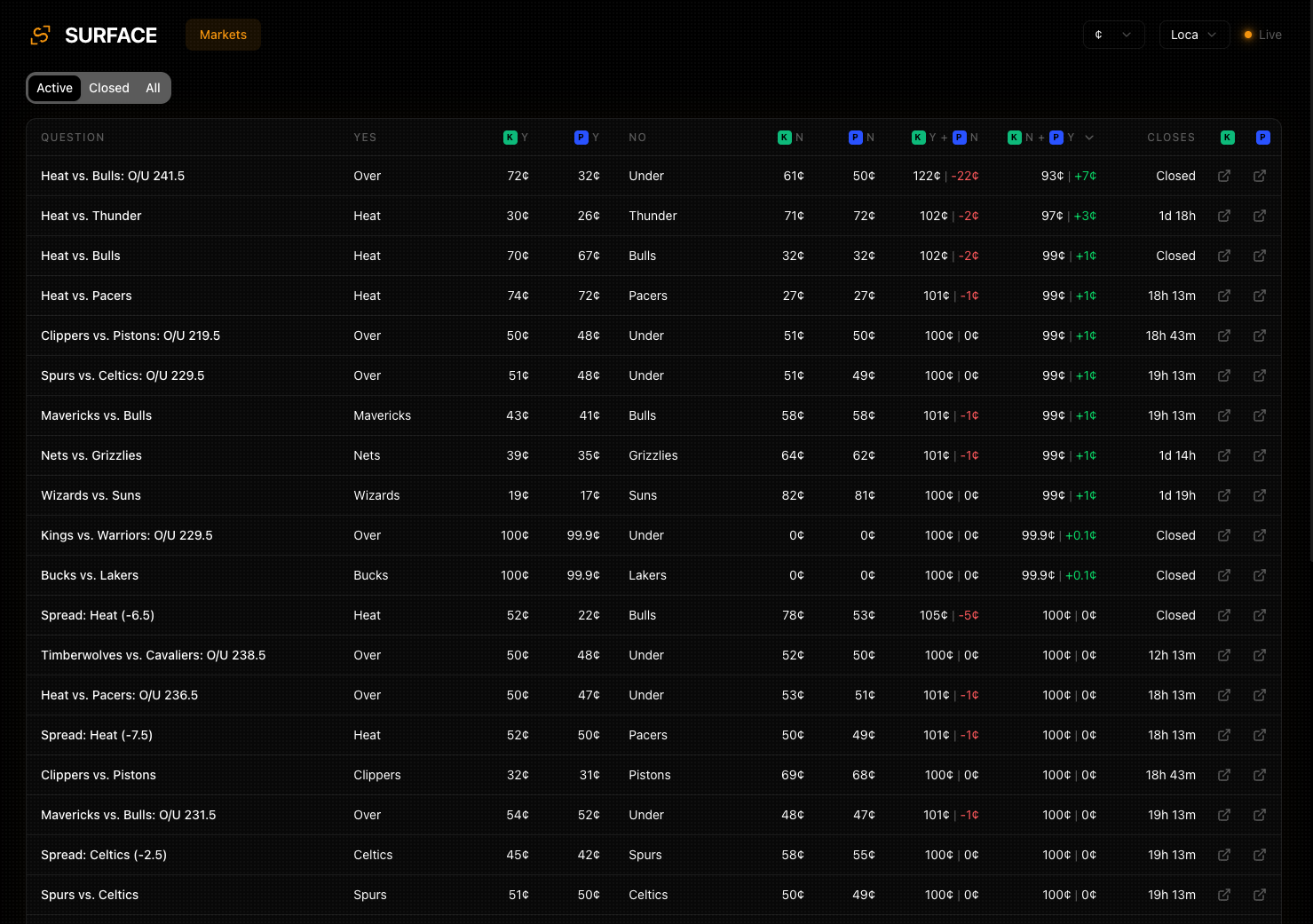
Prediction markets are fragmented. The same event trades on multiple exchanges (Kalshi, Polymarket, and others), often at different prices. Traders manually flip between platforms, miss pricing discrepancies, and have no unified view of where to get the best execution.
There's no single place to see all your options, compare prices, and understand which exchange is leading or lagging on any given market.
What I Built
A matching system that identifies equivalent markets across exchanges and surfaces them in one place. When "Lakers to win" is priced at 55¢ on one exchange and 60¢ on another, Surface shows you both - and the spread between them.
The terminal is cross-exchange only. No exchange-specific markets cluttering the view. If a market doesn't exist on multiple platforms, it doesn't show up. This keeps the focus on what matters: finding the best price and spotting inefficiencies.
What It Offers
- Best price discovery: See where any market is cheapest to buy or most profitable to sell
- Arbitrage surfacing: Identify pricing discrepancies between exchanges in real-time
- Exchange analysis: Understand which platforms lead or lag on pricing for different market types
- Unified trading view: One terminal for markets that exist across exchanges
The Vision
Surface is the foundation for something bigger: an integrated sports data trading terminal. Think Baseball Savant meets prediction markets. Live game data, player metrics, box scores, matchups, all contextualizing the markets you're trading. The goal is to help traders make statistically informed decisions, not just react to price movements.
For now, the focus is on doing cross-exchange really well. The sports data integration comes next.
Key Features
- -Cross-exchange market matching
- -Real-time price comparison across platforms
- -Arbitrage opportunity detection
- -Exchange price analysis (leading/lagging)
- -Unified view of equivalent markets
Tech